
AI Guidelines
- General Guidelines
- Educational Purpose:
- AI technologies shall be implemented to support TUSD’s educational mission, enhance student learning, improve instructional practices, and streamline district operations.
- Human Oversight:
- AI shall not replace human educators, administrators, or staff. All decisions involving AI are subject to human review and approval.
- Ethical Use:
- All AI systems must follow the district's values of fairness, equality, and inclusivity. AI systems must be checked often to make sure they treat everyone fairly and do not cause discrimination.
- Regulatory Compliance:
- All AI used in TUSD must follow federal and state laws, including those that protect student privacy, internet safety, and the rights of students with disabilities.
- Data Privacy and Security:
- The district shall not use AI systems that compromise personally identifiable information (PII) or other sensitive data. All AI platforms must undergo a privacy and security review before use.
- Educational Purpose:
- Guidelines for Staff
- AI Integration in Teaching
- AI tools may be used to support classroom instruction but shall not replace teachers in delivering curriculum or assessing student work. Teachers are responsible for reviewing all AI-generated content before use with students. Teachers may only use district approved AI tools with students.
- Data Privacy and FERPA Compliance
- Staff must ensure no personally identifiable information (PII), student records, or sensitive information is shared with generative AI systems. All data use must comply with FERPA and district privacy policies.
- Professional Development
- TUSD will offer training and learning opportunities about using AI, understanding how it works, and using it ethically. Staff members are strongly encouraged to complete this training before using AI tools in teaching or school administration.
- Academic Integrity
- Teachers must clearly explain the rules for using AI in their classrooms and make sure students follow these rules. If AI tools are allowed in class, teachers need to supervise and help students use them correctly, following any extra guidelines from the school. If someone uses AI tools incorrectly, teachers must report it according to district rules, including the Student Code of Conduct and Staff Conduct Regulations. Misusing AI is treated like any other rule-breaking in the Student Code of Conduct.
- AI Integration in Teaching
- Regulations for Student Use
- Restricted AI Access
- Students are not allowed to use open generative AI platforms on devices provided by the district. Access to these websites will be blocked on all TUSD devices, such as laptops, iPads, and desktop computers.
- Acceptable Use
- Students can only use AI tools under the supervision of a teacher or instructional staff or with pre-approved teacher-assigned activities using vetted and approved tools. School administration and the TUSD Curriculum and Instruction Department may develop further guidelines to approve classroom use of AI or documentation of the use of AI in classrooms, with the approval of the regional superintendent or designated local education agency.
- Use of Closed, Compliant AI Systems
- Students may only use AI tools that comply with COPPA regulations and have been approved by the district for educational purposes.
- Academic Integrity
- Students must follow the guidelines given by their teachers about using generative AI tools. If a teacher doesn't provide guidelines, students should not use AI tools. Students are not allowed to use AI in ways that break school rules, such as cheating, copying work, or making up information. Breaking these rules will be handled according to the Student Code of Conduct.
- Digital Citizenship
- The district will provide guidance to students on responsible AI use, ensuring they understand its ethical and legal implications. Digital citizenship education shall include AI literacy and data privacy awareness. AI literacy is defined, according to DigitalPromise.org as the knowledge and skills that enable humans to critically understand, evaluate, and use AI systems and tools to safely and ethically participate.
- Parents: Technology Agreement
- Document to sign when enrolled/registered, please reference page 44 (48 of 52 in pdf format) of the parent and guardian rights in Student Code of Conduct.
- Restricted AI Access
- AI Use for Administrative Purposes
- Efficiency and Support
- AI may be used to streamline administrative tasks as long as it does not replace human oversight or decision-making.
- Bias Monitoring
- AI tools used in administration must be regularly audited for bias and inaccuracies. Administrators are responsible for ensuring AI outputs are fair, objective, and aligned with district policies.
- Data Security Compliance
- All AI tools used in administration must meet stringent data privacy requirements and comply with district and state regulations. No PII, sensitive or confidential information shall be processed by AI systems without proper authorization and safeguards.
- Integrity of AI Use
- Staff members must ensure compliance with the policies regarding the use of AI. Misuse of AI tools will be treated as a violation and will be addressed in accordance to the Staff Conduct Regulations.
- Efficiency and Support
AI Generated Images
All of these images were generated using written prompts with Adobe Express.
Use the arrows to explore these AI generated images!

Purpose
This policy sets clear rules for using Artificial Intelligence (AI) in the Tucson Unified School District (TUSD). It explains how AI should be used safely and responsibly in classrooms, school offices, and other activities. The policy makes sure everyone's privacy is protected, AI is used fairly, and all students have equal opportunities to learn.
Scope
This policy applies to all students, teachers, staff, administrators, and other people who use or create AI tools at Tucson Unified School District (TUSD). It includes guidelines for using different types of AI, like chatbots, automated software, tutoring programs, and tools that analyze data. These guidelines cover how AI can be used in teaching, school operations, and administration.
AI Definitions
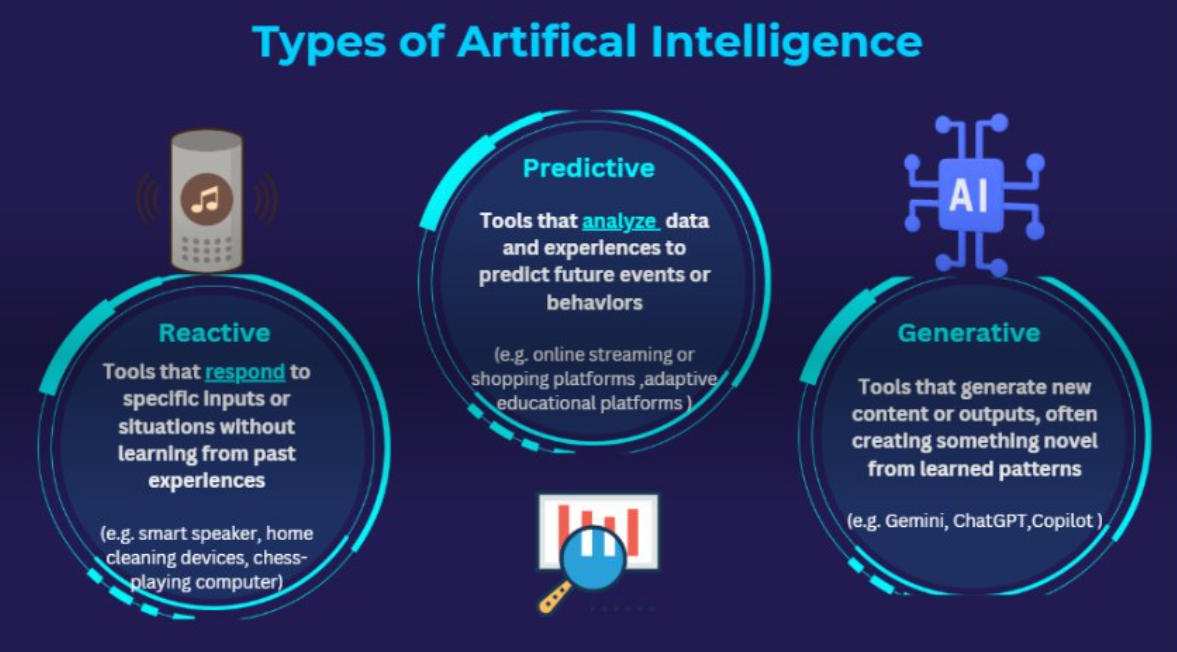
Artificial Intelligence: AI is a part of computer science working to create systems able to perform human-like tasks: make decisions, recognize patterns, and understand language.
Generative AI: One part of AI that is designed to create new content, predictions, or recommendations using large language models (LLMs), like ChatGPT, Google Gemini, and others.
Closed AI Systems: Some AI programs are owned by specific companies or groups, and only they can use them. These programs, called proprietary AI, are kept secret to protect the company's intellectual property. They operate in secure spaces to make sure information stays private and safe.
Open AI Systems: AI models and tools that are created collaboratively by and are generally open to anyone. Because these can encourage innovation and participation by many and diverse people, these models and tools do not always guarantee that your data is private or protected automatically.
Compliant AI Systems: AI programs that follow all necssary laws and guidelines, act ethically, and make sure the information they use is handled safely and legally.
Evaluation and Monitoring
- Approval and Purchasing of AI tools: The TUSD Software Approval Process or Technology Purchase Process applies to the evaluation and selection of AI tools.
- Ongoing Monitoring: The district will continuously monitor the use of AI systems to ensure compliance with this policy. New AI tools and updates to existing systems will be vetted before deployment in TUSD.
- Audits: Regular audits will be conducted to assess AI tool performance, effectiveness, and potential biases. The district reserves the right to discontinue use of AI systems that do not meet TUSD’s standards of equity, privacy, and safety.
References
- FERPA: Family Educational Rights and Privacy Act
- COPPA: Children’s Online Privacy Protection Act
- IDEA: Individuals with Disabilities Education Act
- CIPA: Children’s Internet Protection Act
- Section 504: Rehabilitation Act
- TUSD Student Code of Conduct
- Policy Code EJA-R: Acceptable Use of Technology Resources (Regulation)
- Policy Code GBEB-R: Staff Conduct Regulations